Crete: Europe's Fiber Optic Hub & the Undersea Cable Cold War
The Island at the Crossroads of Global Connectivity
Crete is rapidly solidifying its position as the European gateway to the international Internet. With more than 12 international fiber optic cables either connected or in advanced stages of deployment, the island has become one of the most strategically significant digital nodes in the Mediterranean basin. As of early 2025, an estimated 570 active submarine cable systems span the world's oceans, with roughly 80 more under construction or in advanced planning. Collectively, these fiber-optic systems stretch approximately 1.4 to 1.5 million kilometers along the seabed — forming the invisible backbone of global digital connectivity. Despite what the public perceives as a "wireless" and "cloud-based" Internet, approximately 95 to 99 percent of all intercontinental data traffic — including telephone calls, financial transactions, and cloud computing — travels through submarine cables, not satellites.
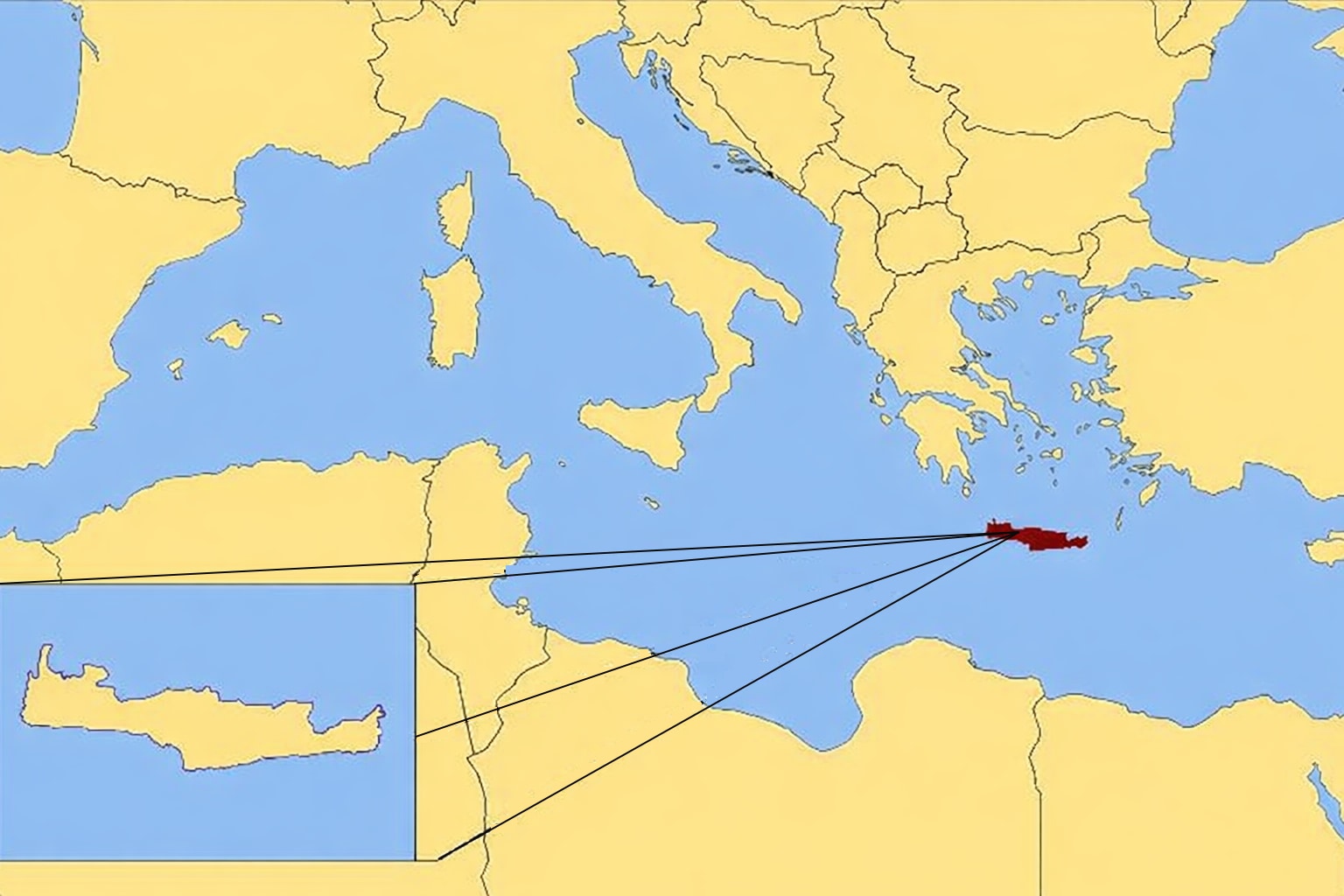
Crete's geographic advantage is hard to overstate. Positioned at the southern edge of the Aegean Sea, the island sits at the intersection of three continents. It is closer to the Middle East and North Africa than almost any other point in the European Union, yet it falls squarely under the NATO security umbrella and the EU regulatory framework. This combination — proximity to fast-growing markets in Africa and Asia, plus the legal stability and security guarantees of Western institutions — is rare and highly attractive to the technology giants and telecom operators who are building the next generation of global infrastructure.
2Africa and Crete's Cable Landing Stations
The most high-profile cable project anchoring Crete's new role is 2Africa, the largest subsea cable system in the world. At approximately 45,000 kilometers in length, 2Africa connects 46 cable landing stations across 33 countries on three continents: Africa, Europe, and Asia. It is the first subsea cable system designed to offer continuous capacity around the entire African continent. The system uses spatial division multiplexing (SDM) technology and has a design capacity of up to 180 terabits per second (Tbps) across 16 fiber pairs. In November 2025, Meta announced that the core 2Africa system had been completed, though Red Sea conflicts have caused indefinite delays in some segments. The project is funded by a consortium of eight international partners: Bayobab, Center3, China Mobile International, Meta, Orange, Telecom Egypt, Vodafone Group, and WIOCC, with Alcatel Submarine Networks responsible for cable construction and installation.
Vodafone Greece operates the cable landing station at Tympaki, in the southern part of Crete — the first major landing station on the island's south coast. This new facility was designed to diversify Crete's connectivity away from the northern shore, where most submarine cables have historically been concentrated. Tympaki connects to the city of Heraklion via 30 kilometers of cable conduits and 280 kilometers of new optical fiber, making it a central hub for regional connectivity.
In addition to 2Africa, the Tympaki station also hosts the India-Europe-Xpress (IEX) subsea cable system, a nearly 10,000-kilometer link connecting Mumbai to Europe, with extensions eastward to Singapore through the India-Asia-Xpress (IAX) system. The IEX cable also reaches the Middle East and Africa, with landings in Oman, Djibouti, Saudi Arabia, Egypt, France, and Italy.
In February 2026, Grid Telecom — a subsidiary of the Independent Power Transmission Operator (IPTO) of Greece — announced the construction of ARTEMIS, an ultra-high-capacity subsea optical fiber cable connecting Crete to mainland Greece (the Attica region). Spanning approximately 280 kilometers including terrestrial segments, ARTEMIS will carry data at up to 30 Tbps per fiber-pair, with a minimum of 24 fiber-pairs and an overall design capacity of at least 720 Tbps. Engineered to exploit the relatively short transmission distance and support next-generation optical spectrum expansion, ARTEMIS is poised to become the first petabit-class subsea cable in both Greece and the Mediterranean, with a potential total capacity exceeding 1 petabit per second. Grid Telecom's existing infrastructure already connects Crete to the mainland through its Minoas East-West and Apollo East-West systems via four independent routes and 96 fiber-pairs.
Other major systems landing or routed through the region include SEA-ME-WE 6 (the latest iteration of the cable that first connected East Asia and Europe in 1985, now carrying 10 fiber pairs at 12.6 Tbps each from Singapore to Marseille), and Andromeda (linking Korakia in Crete to Tirat Carmel in Israel).
The Anatomy of a Submarine Cable
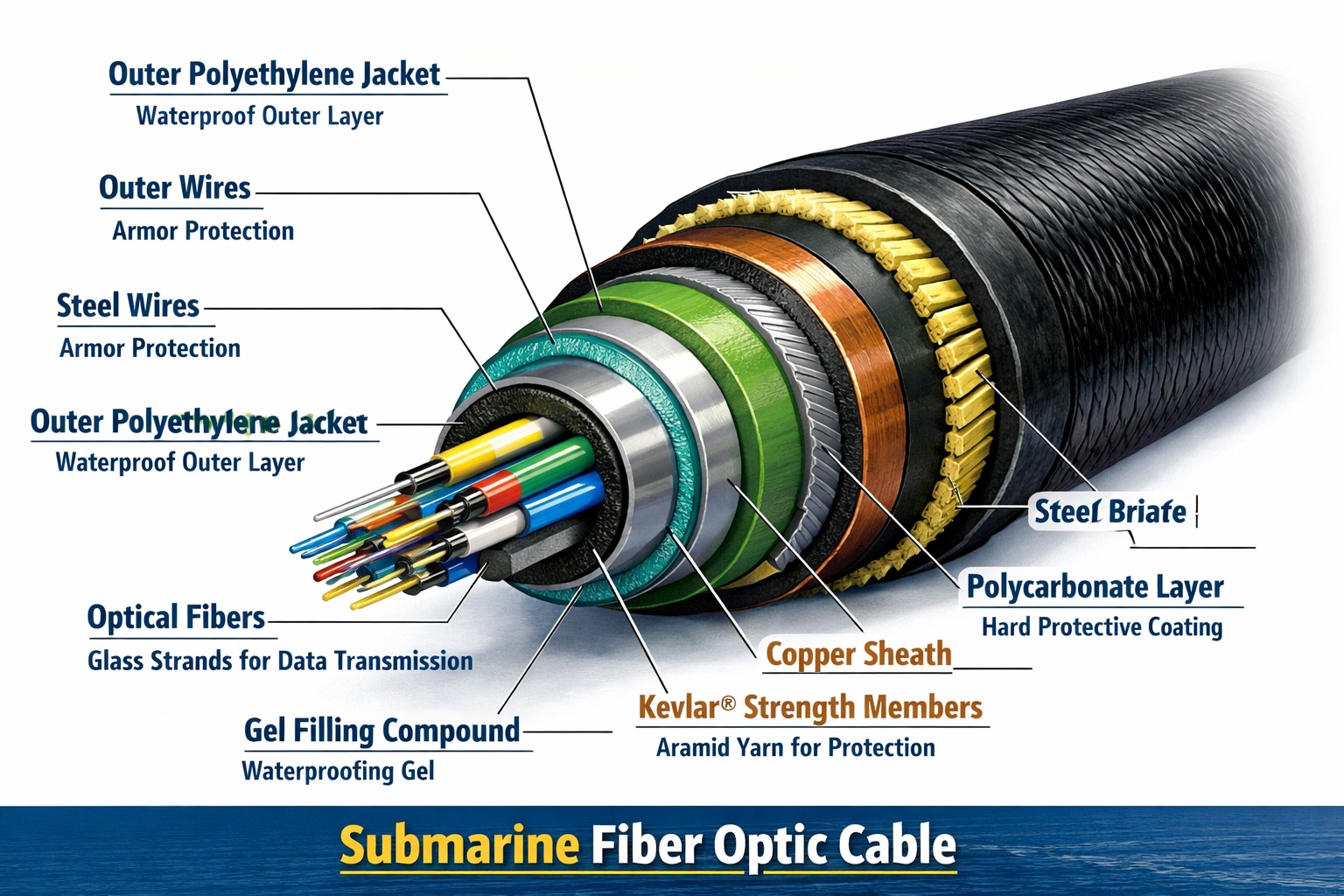
Although submarine cables are invisible to the average user, they are marvels of engineering. From the outside, a modern subsea cable looks deceptively simple — about 25 millimeters (roughly one inch) in diameter, no thicker than a garden hose, and weighing around 1.4 tonnes per kilometer. But cut one open and you find layers of sophisticated protection. At the very center are ultra-pure silica glass optical fibers, each as thin as a human hair, capable of transmitting data as rapid pulses of laser light. Modern submarine cables typically contain between 4 and 48 fiber pairs and often use G.654 fiber specifically designed for long underwater distances, achieving signal loss as low as 0.15 to 0.17 dB/km — far better than standard land-based fibers. Surrounding the glass core is a stainless steel tube filled with protective gel, then successive layers of copper conductors (for powering repeaters), nylon, steel wire armor, and tar for waterproofing.
Submarine Fiber-optic cable cutaway
Active fiber-optic cables require repeaters at regular intervals — typically every 60 to 100 kilometers — to amplify optical signals. These use erbium-doped fiber amplifiers (EDFAs), powered by a constant direct current of up to 1,100 milliamps at voltages from 3,000 to 15,000 volts DC that runs through the cable's central conductor. All repeaters in a cable are wired in series, with power supplied from terminal stations at both ends. The total power fed into a cable can reach 16.5 kilowatts.
Despite their armor, cables remain vulnerable. Roughly 100 to 150 cable faults occur worldwide each year, with the majority caused by fishing trawlers and ship anchors in shallow waters. Natural hazards — earthquakes, undersea landslides, volcanic eruptions — account for a smaller but potentially catastrophic share. And increasingly, deliberate human sabotage has emerged as a significant threat.
The Lesson of Tonga: What Happens When Cables Are Destroyed
The devastating case of the Pacific island nation of Tonga illustrates what cable loss can mean for an entire country. In January 2022, the eruption of the Hunga Tonga–Hunga Ha'apai volcano triggered a massive undersea landslide that severed 55 miles of Tonga's international cable and 65 miles of its domestic network. The cable was physically displaced kilometers from its original position and buried under tons of volcanic mud.
The consequences were immediate and far-reaching. ATMs stopped functioning. Banks could not verify accounts or process transactions. International trade effectively collapsed. Citizens could not contact relatives overseas, and remittances from abroad — which represented approximately 44 percent of Tonga's GDP — were abruptly cut off. Hospitals lost the ability to exchange medical records. Schools resorted to broadcasting lessons over the radio.
Recovery was agonizingly slow. The specialized cable repair ship Reliance took days simply to reach the site, as crews had to wait for volcanic ash to clear from the atmosphere and ensure the volcano would not erupt again. Technicians then had to use special deep-sea hooks to locate and retrieve the severed cable ends from depths of thousands of meters, only to discover the cable had been moved far from its charted position.
The Baltic Sea: Europe's Sabotage Proving Ground
While natural disasters like Tonga's illustrate the fragility of the global cable network, the deliberate severing of cables represents an entirely different — and arguably more dangerous — category of threat. The Baltic Sea has become the primary theater for what analysts call "gray zone warfare" against undersea infrastructure: actions that fall below the threshold of armed conflict but inflict enormous damage on the opponent. The main advantage of sabotage at the bottom of the sea is plausible deniability — it is extremely difficult to prove whether a cable was cut by a "wandering" anchor or by a specialized mechanism deployed by a hostile state.
Since Russia's invasion of Ukraine in February 2022, the Baltic region has experienced a sustained and escalating wave of suspicious undersea incidents. The region is particularly vulnerable: the Baltic is shallow (averaging only about 55 meters in depth), making cables more accessible to surface vessels, and it is heavily trafficked, with as many as 4,000 ships transiting daily. Nine of the ten Baltic littoral states are now NATO members, and Russia — bordering the sea through St. Petersburg and the Kaliningrad exclave — has strong strategic motivation to threaten the alliance's critical infrastructure.
A detailed timeline of incidents reveals the scale of the problem:
September 2022 — Nord Stream Pipelines: The Nord Stream 1 and Nord Stream 2 gas pipelines were destroyed by underwater explosions in Swedish and Danish exclusive economic zones. Sweden found traces of explosives, confirming deliberate sabotage. Investigations were closed without naming suspects, though a Ukrainian diving instructor was later sought by German prosecutors.
October 2023 — Balticconnector and Data Cables: The Balticconnector gas pipeline linking Finland and Estonia was severed by the Chinese-flagged container vessel Newnew Polar Bear, which dragged its anchor across the seabed for over 100 miles. The same ship is suspected of damaging telecommunications cables connecting Estonia to Finland and Sweden. The vessel had recently completed a transit through Russia's Northern Sea Route from the naval base at Baltiysk (Kaliningrad). Finland recovered the ship's missing anchor near the ruptured pipeline. China initially denied involvement but admitted responsibility in August 2024, attributing the damage to "bad weather." The vessel's captain was remanded in custody in Hong Kong in May 2025.
November 2024 — BCS East-West Interlink and C-Lion1: Two fiber-optic cables, more than 200 kilometers apart, were severed within 24 hours: the BCS East-West Interlink (connecting Sweden and Lithuania) and the C-Lion1 (connecting Finland and Germany). Lithuania lost approximately one-fifth of its Internet capacity temporarily. Investigators focused on the Chinese bulk carrier Yi Peng 3, whose coordinates corresponded precisely to the time and location of both breaks. The ship was held at anchor in the Kattegat under Danish naval guard for weeks as a diplomatic standoff unfolded between European nations and China. Representatives from Germany, Sweden, Finland, and Denmark were eventually allowed aboard in late December 2024.
December 2024 — Estlink 2 Power Cable and Data Lines: On Christmas Day, the Estlink 2 power cable between Finland and Estonia was damaged, along with four other telecom lines. Finnish authorities seized the Cook Islands-flagged tanker Eagle S, which was linked to Russia's "shadow fleet" — an estimated fleet of up to 600 vessels with obscure ownership used to circumvent EU oil sanctions. Vast amounts of surveillance equipment were reportedly found on board. The damaged Estlink 2 cable was not fully repaired until August 2025, an outage lasting more than seven months.
January–February 2025 — Additional Incidents: A fiber-optic cable linking Latvia to Sweden's Gotland island was damaged on January 26. Sweden seized the Maltese-flagged vessel Vezhen, though a prosecutor later ruled the damage accidental. The following month, the C-Lion1 link between Finland and Germany reported new problems, possibly dating to the same January timeframe. In late December 2025, Finnish police seized the cargo vessel Fitburg, en route from Russia to Israel, on suspicion of sabotaging an Elisa telecoms cable across the Gulf of Finland. Five days later, Latvian authorities boarded another vessel suspected of damaging a telecom link to Lithuania.
In total, since 2022, at least ten subsea cables and pipelines have been cut or damaged in the Baltic Sea in suspicious circumstances, with seven incidents occurring in a concentrated period from November 2024 to January 2025 alone.
The EU Mobilizes: €347 Million for Cable Security
In response to this escalating campaign, the European Union has launched its most comprehensive initiative to date: the EU Action Plan on Cable Security. On February 9, 2025, at the Baltic Energy Independence Day in Vilnius, European Commission President Ursula von der Leyen outlined four priorities: prevention, detection, response and repair, and deterrence.
In February 2026, the Commission released its Cable Security Toolbox, comprising six strategic measures and four technical and support measures to improve the security and resilience of submarine cable infrastructure. This was informed by an EU-wide risk assessment published in October 2025 that systematically identified threat scenarios, vulnerabilities, and dependencies.
The financial commitment is substantial. The Commission amended its Connecting Europe Facility (CEF) Digital Work Programme to allocate €347 million specifically for strategic submarine cable projects. The funding breaks down as follows:
€60 million (2026) for cable repair modules — pre-positioned equipment at ports and shipyards to enable rapid restoration of cable services after damage.
€20 million (2026) for SMART cable systems — sensors and monitoring components integrated directly into submarine telecommunications infrastructure to gather real-time oceanographic and seismic data, effectively turning every cable into a surveillance and early-warning network.
€267 million (2026–2027) for Cable Projects of European Interest (CPEIs) — a list of 13 priority areas for public funding, organized in three five-year stages extending to 2040, designed to strengthen cable resilience and redundancy across all major EU sea basins.
This is in addition to existing commitments: from 2021 to 2024, the EU provided €420 million to 51 backbone cable connectivity projects, and under the current CEF Digital multiannual work programme (2024–2027), a total of €533 million has been allocated for submarine cable projects, with €186 million already awarded to 25 projects. Including planned investments through 2027, total EU spending on submarine cable infrastructure approaches €1 billion under the current financial framework.
The first repair-module call, for €20 million, opened in February 2026 and focuses initially on the Baltic Sea — the epicenter of recent disruptions — before expanding to the Mediterranean and Atlantic basins. The industry currently relies on a small, aging fleet of fewer than 100 specialized cable repair ships to cover the entire globe, so strengthening regional repair capacity is critical to reducing response times from weeks to days.
Beyond funding, the EU is leveraging its sanctions regimes, particularly against Russia's destabilizing activities. Measures target the "shadow fleet" of vessels with obscure ownership and insurance, and the EU and G7 are exploring further options to de-flag vessels that flout maritime law. NATO has also established Operation Baltic Sentry, a dedicated multinational patrol using frigates, aircraft, and underwater drones to monitor critical seabed infrastructure.
The Shift in Ownership: From Telecoms to Tech Giants
A structural transformation has reshaped the submarine cable industry over the past decade. Ownership and financing of new cable capacity has shifted decisively from traditional telecommunications companies to the major technology platforms — often called Over-The-Top (OTT) companies. Today, companies like Google, Meta, Amazon, and Microsoft finance more than 80 percent of new submarine cable capacity worldwide. This reflects the staggering data demands of cloud computing, video streaming, AI training, and social media, which have far outpaced the capacity investment of traditional carriers.
The global submarine optical fiber cable market reflects this surge: valued at approximately $16.7 billion in 2025, it is projected to reach roughly $29.7 billion by 2032, growing at a compound annual rate of about 8.5 percent. Some estimates project even faster growth, with the market potentially reaching over $80 billion by 2035 at a 12.1 percent CAGR, driven by 5G deployment, hyperscale data center expansion, and rising demand for low-latency intercontinental connectivity.
This concentration of critical global infrastructure in the hands of a few private companies raises significant policy questions about sovereignty, security, and competition. When a handful of American firms control the majority of the world's new data highways, the geopolitical implications are profound — particularly for nations and regions that depend on these cables but have little influence over their routing, landing, or governance.
The New "Cold War" of the Deep Sea: Sabotage, Surveillance, and Splinternet
Geopolitical analysts warn that the escalating confrontation between the United States and China increasingly extends beneath the ocean surface. The risk of a Splinternet — a fragmented Internet divided between incompatible American and Chinese spheres — grows as both powers build separate and competing cable networks.
The confrontation plays out across three dimensions:
Sabotage: The deliberate cutting or damaging of undersea cables as an instrument of hybrid warfare. This is not a new tactic — on the very first night of World War I, the British ship Telconia cut five German submarine telegraph cables in the English Channel, isolating Germany from transatlantic communications. Today's version is more sophisticated but operates on the same principle. In 2023, two cables connecting Taiwan's Matsu Islands were severed by Chinese vessels within six days. Although China characterized this as accidental, many analysts viewed it as a rehearsal for a broader blockade scenario. More alarmingly, China recently unveiled a specialized deep-sea cable-cutting submersible — a vessel with no plausible commercial purpose, clearly designed for infrastructure sabotage. Russia's research vessel Yantar and its special-mission submarines, equipped with manipulator arms, have long concerned NATO planners, who fear that in a major conflict, Russia could sever the transatlantic cables connecting Europe to the United States, paralyzing financial markets and military communications simultaneously.
Surveillance: Intelligence agencies (notably the NSA and GCHQ) have long used cable landing stations as collection points for mass data interception. Techniques now exist to place sensors directly on optical fibers that can read light signals without interrupting the data flow. Countries like Djibouti and Egypt — which host dozens of cable landing points due to their positions at critical maritime chokepoints — wield outsized geopolitical leverage because they can theoretically or practically access vast amounts of data transiting their territory.
Exclusion: The United States is actively blocking Chinese companies, particularly HMN Tech (formerly Huawei Marine Networks), from participating in cable projects that touch American territory. Washington promotes the concept of a "clean" network free of Chinese technology, citing espionage risks. China has responded by delaying cable-laying permits in the South China Sea and funding its own systems — such as the EMA network, a $500 million project designed to bypass Western infrastructure — as a rival to American-controlled routes. Beijing is methodically building an alternative digital infrastructure that could eventually serve as the backbone of a separate Internet ecosystem.
The Challenge of Defense
The book "The Web Beneath the Waves: The Fragile Cables That Connect Our World" by journalist Samanth Subramanian concludes with a sobering assessment: it is practically impossible to police hundreds of thousands of miles of cable across the vast oceans. States are investing in underwater drones for surveillance and building "resilience networks" — laying redundant cables so that if one route is cut, traffic can be rerouted through alternatives. The first and most fundamental line of defense is not physical security but network architecture: no country should depend on a single route or a single landing station. Creating a "mesh" of cables ensures that sabotage or accident on one link does not bring down the entire system. Landing stations should be distributed across multiple points along a nation's coastline so that a localized catastrophe — an earthquake, a targeted strike on a coastal city — does not isolate the entire territory.
But as Subramanian notes, sabotage technology is always one step ahead of protection technology. The invisible cables on the ocean floor may be the most vulnerable critical infrastructure of modern civilization. In a future conflict, the first blow may not be a missile striking land, but a cable severed silently in the unguarded depths — plunging nations into digital darkness before a single shot is fired.
Sources: Submarine Networks, Vodafone, European Commission (CEF Digital), EUR-Lex EU Action Plan on Cable Security, Wikipedia, Reuters, MarineLink, Atlantic Council, Bulletin of the Atomic Scientists, Eurasia Review, Grid Telecom, eeNews Europe, Bloomberg/Energy Connects.